Queer Places:
Lismore Castle, Lismore, Co. Waterford, P51 EY68, Ireland
Harrow School, 5 High St, Harrow HA1 3HP, United Kingdom
University of Cambridge, 4 Mill Ln, Cambridge CB2 1RZ
Romsey House, 274 Mill Rd, Cambridge CB1 3NL, UK
Mill Road Cemetery, Mill Rd, Cambridge CB1 2AW, United Kingdom
 William Edmund Currey (December 10, 1840 – December 3, 1908) was born on December 10, 1840, at Lismore Castle in County Waterford, Ireland. He was the eldest son of Francis
Edmund Currey and Anna Currey. His father, a Cambridge graduate and barrister, served as the land agent for the Duke of Devonshire starting in 1839. Operating from Lismore
Castle, Francis Currey played a significant and compassionate role during the Great Irish Famine, helping to run the estate with fairness and directing generous
contributions toward local relief schemes. Francis also oversaw the extensive Victorian remodeling of Lismore Castle led by Sir Joseph Paxton during the 1850s, a legacy for
which he was later commemorated in St. Carthage Cathedral.
William Edmund Currey (December 10, 1840 – December 3, 1908) was born on December 10, 1840, at Lismore Castle in County Waterford, Ireland. He was the eldest son of Francis
Edmund Currey and Anna Currey. His father, a Cambridge graduate and barrister, served as the land agent for the Duke of Devonshire starting in 1839. Operating from Lismore
Castle, Francis Currey played a significant and compassionate role during the Great Irish Famine, helping to run the estate with fairness and directing generous
contributions toward local relief schemes. Francis also oversaw the extensive Victorian remodeling of Lismore Castle led by Sir Joseph Paxton during the 1850s, a legacy for
which he was later commemorated in St. Carthage Cathedral.
Growing up against this privileged and historic backdrop, William followed an elite educational path. He attended Harrow School before being admitted as a pensioner to
Trinity College, Cambridge, on November 23, 1858. He matriculated in the autumn of 1859, became a scholar in 1861, and graduated with a Bachelor of Arts in 1863 as the 5th
Classic in the Classical Tripos. During his time at Cambridge, he was also inducted into the prestigious secret intellectual society known as the
Cambridge Apostles. He earned his Master of Arts in 1866, was elected a Fellow of Trinity College in 1865, and served the
college as a tutor from 1866 until 1871.
Transitioning from academia to public service, Currey was appointed an Inspector of Schools in April 1871. Shortly thereafter, on May 20, 1871, he married Emma Jane
Bennett. The couple did not have children. Over the course of his career as an educational inspector, Currey and his wife lived in various locations, including Towcester in
Northamptonshire and Kensington in London. By 1901, they had returned to Cambridge, residing on Brooklands Avenue with domestic staff. Currey eventually rose to become the
Chief Inspector of Schools for the Eastern Division.
Regarding potential LGBTQ links, while his membership in the Cambridge Apostles—a society historically known for nurturing intimate homosocial and homoerotic bonds among
elite Victorian intellectuals—places him within a social network that frequently intersected with same-sex romantic and intellectual currents, no specific or direct
historical evidence links Currey himself to LGBTQ relationships or scandals. His life proceeded along conventional Victorian upper-middle-class lines, culminating in his
marriage to Emma Jane Bennett, with whom he remained until the end of his life.
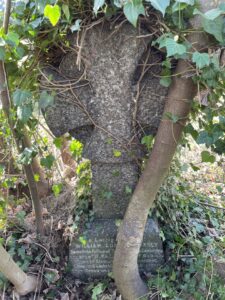
William Edmund Currey died on December 3, 1908, at the age of 67 at Romsey House on Mill Road in Cambridge. He was buried in Cambridge, where his widow erected a Celtic
cross and kerbstone monument in St. Paul's parish area to honor his memory as a sometime Fellow of Trinity College and a dedicated Her Majesty's Inspector of Schools.
References:
Other references:
- Cambridge Family History Society Survey: Parish records and monumental inscription surveys detailing the Celtic cross and kerb stones located in the parish area of St. Paul (Cambridge), including the transcribed memorial text recording his birth, death, and position as a Fellow of Trinity College and H.M. Inspector of Schools.
- Harrow School Register: Official biographical records documenting his enrollment and education at Harrow School.
- Alumni Cantabrigienses & Trinity College Admissions Records: University administrative records tracking his admission as a pensioner on November 23, 1858, his matriculation in 1859, his scholarship in 1861, his 5th Classic standing in the Classical Tripos and BA graduation in 1863, his MA in 1866, and his election as a Fellow in 1865 alongside his tenure as a college tutor (1866–1870/1871).
- The Times (Obituary Notice): Death and biographical notice published on December 9, 1908, documenting his passing and career details.
- UK Census Records (1881, 1891, 1901): Historical enumeration data detailing his residences, including Park Street in Towcester, 77 Warwick Road in Kensington, and Mostyn House on Brooklands Avenue in Cambridge, alongside household arrangements.
- National Probate Calendar (England and Wales): Official probate and estate records documenting his death on December 3, 1908, at Romsey House, Cambridge, and confirming his professional designation as Chief Inspector of Schools for the Eastern Division.
- Irish Land Estate and Family Archives (Lismore Castle / Duke of Devonshire Papers): Historical records regarding Francis Edmund Currey's administration as land agent at Lismore Castle, County Waterford, documenting family lineage, his role during the Great Irish Famine, and his commemoration via a stained glass window in St. Carthage Cathedral.
- Cambridge Apostles Membership Records: Biographical listings and institutional histories of the Cambridge Apostles tracking the intellectual society's membership throughout the mid-19th century.
Support this project
This website is a passion project researched, developed, and funded entirely by me. If you find the content valuable and would like to help support the ongoing research and hosting costs, any contribution is deeply appreciated.
Thank you for keeping this independent resource alive!
My books on Amazon: Elisa Rolle's books
BACK TO HOME PAGE
